How to Tell When Pumpkin Pie Is Done
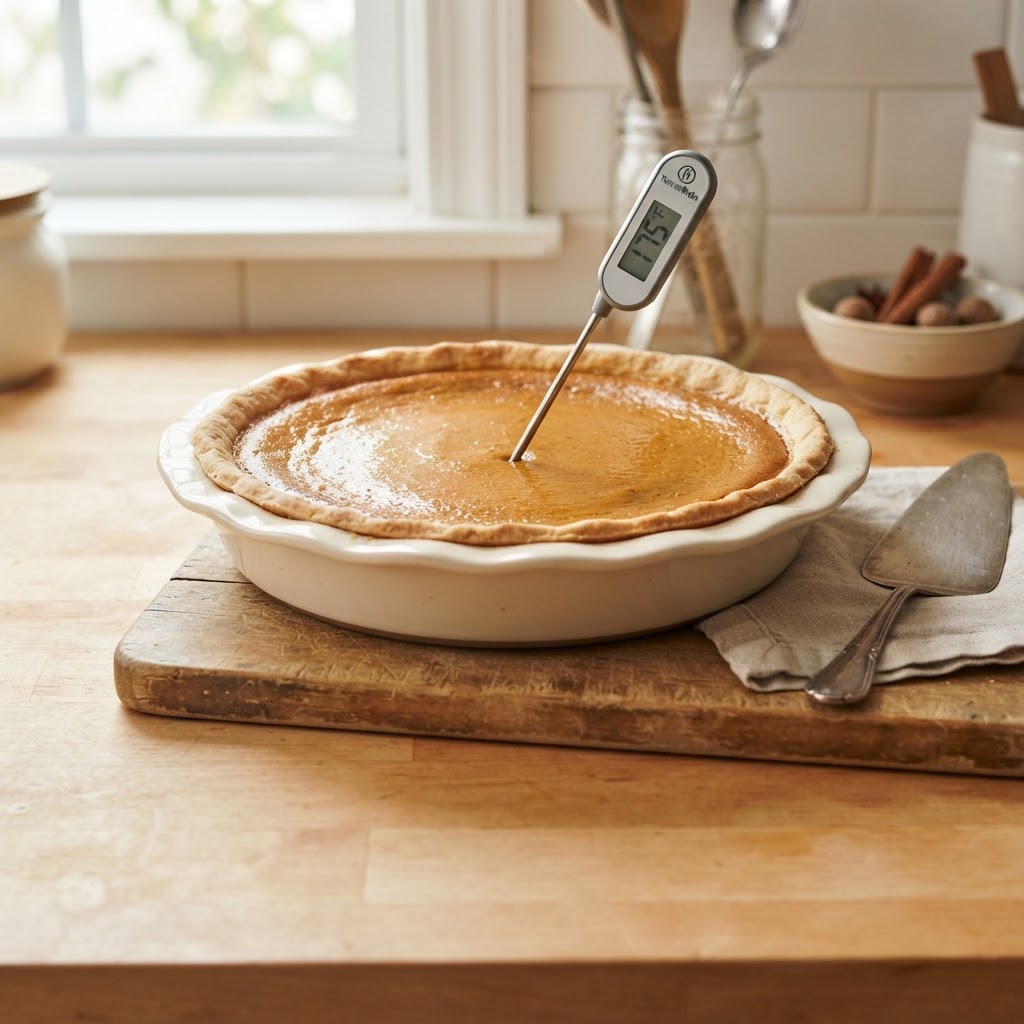
Pumpkin pie is done when the edges are set and the center has a gentle wobble; use a thermometer for confirmation without baking past the ideal point.
Quick reference
- Edge: Set and slightly puffed May pull gently from crust
- Center: Small, soft wobble Not liquid or sloshing
- Thermometer: About 170–175°F Check the filling, not crust
- After baking: Cool fully The custard firms as it rests
Use the center jiggle first
The most useful sign of pumpkin pie doneness is a gentle wobble in the center. When you carefully nudge the pan, the outer area should look set while a small circle in the middle moves like soft gelatin. It should not ripple, look wet, or slosh. A completely motionless center can mean the pie has baked too long, which may lead to cracks or a firm, grainy filling after cooling.
- Small wobble: ready to come out.
- Wide, liquid movement: bake longer.
- No movement at all: check immediately and avoid extended baking.
Check the edges and surface
The edges should be visibly set and may look slightly puffed compared with the center. The filling can pull back a little from the crust, though dramatic shrinking is a sign it has gone too far. The surface should appear mostly matte rather than glossy and fluid. Because ovens, pie plates, filling depth, and crust color vary, use these visual cues together instead of judging by the clock alone.
- Look for a set ring around the outside.
- Expect the center to remain softer than the edges.
- A few small surface cracks usually indicate overbaking, not underbaking.
Use a thermometer without overbaking
For a more precise check, insert an instant-read thermometer into the filling near the center, avoiding the crust and the pan. Aim for roughly 170–175°F. Remove the pie as it approaches that range rather than leaving it in until the center reaches a rigid, high temperature. The reading can vary with recipe proportions, thermometer placement, and oven accuracy, so confirm it with the gentle-jiggle test.
- Insert from the side or top into the custard.
- Take more than one reading if the first seems unusual.
- Do not use the thermometer in a spot touching the hot pan.
Allow for carryover setting
Pumpkin pie continues to set after it leaves the oven. That carryover setting is why the center should look slightly underfirm when you remove it. Place the pie on a rack and let it cool undisturbed; moving or slicing it while warm can make the filling seem loose even when it was baked correctly. The exact cooling time depends on pie depth and room temperature, but plan ahead rather than rushing the finish.
- Cool at room temperature until no longer warm.
- Refrigerate only after the pie has cooled sufficiently.
- Slice fully chilled for the cleanest pieces.
Why the knife test can mislead
A knife inserted into the center is not the best primary test for pumpkin pie. It can leave a visible cut, release filling moisture, and give an unclear result if it hits a soft pocket or the crust. Instead, judge the set edges, the restrained center jiggle, and—when needed—the thermometer reading. These checks preserve the pie’s appearance and better reflect how the custard will finish setting as it cools.
- Use the knife only as a secondary check if your recipe specifically calls for it.
- Trust a small wobble more than a perfectly clean, dry cut.
- Cool fully before deciding the texture is wrong.