How to Scale Baking Recipes Up or Down Without Guessing
Double or halve a baking recipe accurately with practical rules for ingredients, eggs, leaveners, pan size, and bake time.
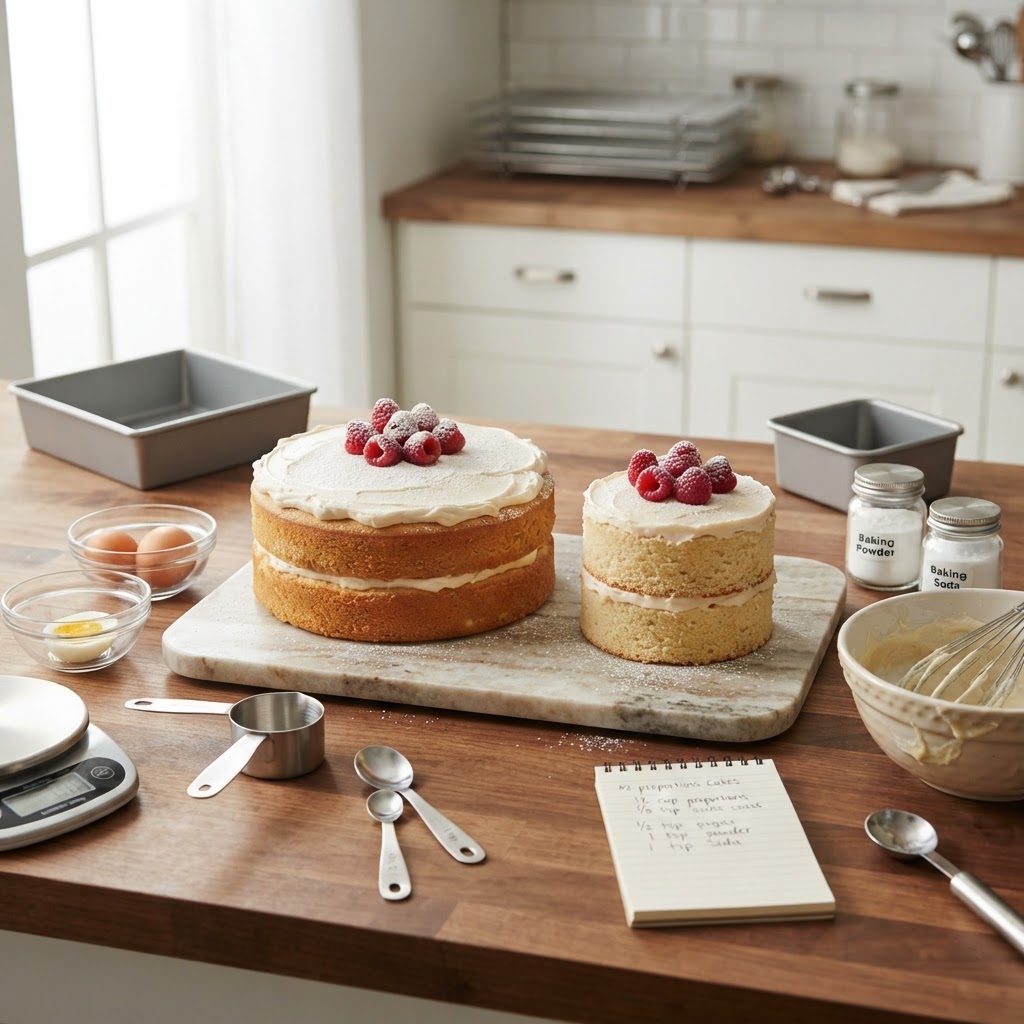
Quick reference
- Recipe change: Ingredient amounts Multiply every amount by the same factor
- Eggs: Beat, then weigh Use the portion required
- Pan size: Match batter depth Keep depth close to the original
- Bake time: Start checking early Time changes less predictably than volume
Start with one scaling factor
For a double batch, multiply every ingredient by 2. For a half batch, multiply by 0.5. Convert awkward measurements before mixing: 1 tablespoon becomes 1½ teaspoons when halved, while ¾ cup becomes ⅜ cup, or 6 tablespoons. Weighing flour, sugar, and other dry ingredients makes conversions more accurate than relying on packed or loosely filled cups.
- Write the new amount beside each original amount.
- Keep units consistent while calculating.
- Scale flavorings carefully; taste-sensitive ingredients may need adjustment.
Handle eggs by weight
Eggs are the most common obstacle when halving a recipe. Crack the required eggs into a bowl, beat until uniform, then weigh or measure the mixture. A large egg without its shell is roughly 3 tablespoons, but actual sizes vary. For half of three eggs, beat all three and use half by weight or volume. In a doubled recipe, use six eggs unless the original formula already specifies a different egg size.
- Do not divide a whole egg by shell count alone.
- Use the same egg size as the original recipe when possible.
Treat leaveners and delicate ingredients thoughtfully
Baking powder and baking soda usually scale with the rest of the recipe, but rounding can matter in a small batch. Measure accurately rather than adding an extra pinch. Salt, spices, extracts, and strongly flavored ingredients can also be scaled mathematically, then adjusted slightly for taste in a familiar recipe. Do not casually change flour, liquid, fat, or sugar ratios: those proportions control the batter’s structure.
- Level small spoon measurements.
- Never compensate for a smaller batch by adding extra leavener.
Choose a pan by batter depth
The pan determines whether a scaled recipe bakes properly. A doubled cake batter needs about twice the original pan area to maintain the same depth; a half batch needs about half the area. A deeper pan can leave the center underbaked while the edges finish, even if the ingredient math is perfect. If no matching pan is available, divide the batter among pans or hold back excess rather than filling a pan too deeply.
- Fill pans only as the original recipe recommends, commonly about half to two-thirds full.
- For round pans, compare area: diameter × diameter is a useful quick guide.
Adjust bake time by appearance, not arithmetic
Do not automatically double or halve the baking time. A larger, similarly shallow batch may take close to the original time; a thicker cake or loaf usually takes longer, while a shallow half batch may finish sooner. Begin checking before the original recipe’s minimum time. Look for the stated doneness cues—set edges, a springy center, a clean tester, or an appropriate internal temperature—and rotate only if your oven bakes unevenly.
- Use the recipe’s visual and texture cues first.
- If the top browns early, tent loosely with foil while the center continues baking.
When multiplying every number fails
Mechanical scaling is less reliable for recipes built around a fixed pan, a stovetop reduction, whipped egg foam, or a small amount of yeast. A doubled cookie dough may need batches because crowded pans change spreading and browning. A large cake may require a different pan shape or a tested formula rather than a deeper pour. For reduced recipes, mixing can also become inaccurate when tiny quantities are rounded. When precision matters, weigh ingredients and make a test batch before serving guests.
- Scale the formula, then reassess pan, mixing, and heat.
- For cookies, bake one test tray before committing the full batch.